
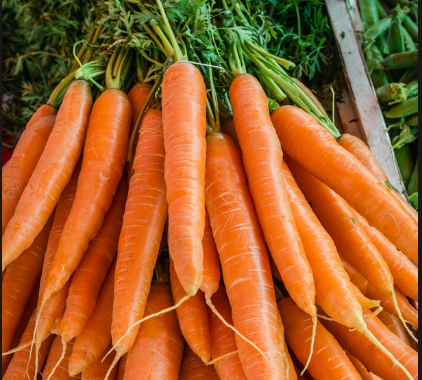
Carrots are rich in nutrients, containing carotene, vitamins, and various amino acids. However, carrot fertilization requires careful attention. Only by mastering reasonable fertilization techniques can carrot yields be increased. So, how should carrots be fertilized, and what fertilizers should be used? Please see the carrot fertilization techniques in this article.
1. Applying Organic Fertilizer to Improve Quality
The early nutrient supply for carrots mainly comes from base fertilizer, which should primarily consist of pig, chicken, cow, horse manure, and human excrement, at 2000-2500 kg per acre. Immediately afterward, spray with an 800-fold dilution of a high-lipid film to protect the fertilizer's effectiveness and prevent pathogens from invading the soil. At the same time, organic fertilizers must be fully decomposed; otherwise, it can easily lead to branching roots, affecting yield and quality.
2. Combined Application of Nitrogen, Phosphorus, and Potassium: Nitrogen promotes the growth of branches and leaves, synthesizing more nutrients; phosphorus facilitates nutrient transport, improves quality, and has a significant impact on the early growth and development of carrots, but its effect is minimal during the flesh enlargement stage, and it is usually applied as a base fertilizer; potassium promotes the meristematic activity of the root cambium, resulting in a significant yield increase. Generally, to produce 1000 kg of carrots per mu (approximately 0.067 hectares), 2.40-4.30 kg of nitrogen (N), 0.70-1.70 kg of phosphorus (P2O5), and 5.70-11.70 kg of potassium (K2O) are required, in a ratio of 1:0.40:2.6. All the required phosphorus fertilizer can be applied as base fertilizer; a portion of the required nitrogen and potassium fertilizer can be applied as base fertilizer, and the remainder can be applied as top dressing during the peak leaf growth period, when the fleshy root diameter reaches 0.60 cm, and when the fleshy root enlarges. After fertilization, spray with an 800-fold dilution of a high-lipid film to improve fertilizer utilization.
3. Application of Micronutrients
Carrots absorb a significant amount of calcium. High calcium levels can decrease the sugar and carotene content of carrots, and calcium deficiency can easily lead to hollow heart disease. Carrots absorb relatively little magnesium; higher magnesium content results in higher sugar and carotene content, leading to better quality. Applying calcium-magnesium-phosphate fertilizer as base fertilizer can increase the calcium and magnesium content in the soil. For boron fertilizer, spray once each during the seedling stage and the peak leaf growth stage, and twice during the fleshy root enlargement stage with a 0.10%-0.25% boric acid solution or borax solution. Simultaneously, use an 800-fold dilution of a high-lipid film to improve the utilization rate of effective fertilizer components. During the initial enlargement stage of the fleshy root, promptly spray with a root-strengthening agent to thicken the nutrient transport vessels in the underground fruit, enhancing fruit enlargement vitality, resulting in smooth fruit surface, healthy fruit shape, and high-quality, high-yield carrots.
The above are the scientific and reasonable fertilization techniques for carrots. We hope this information is helpful!