
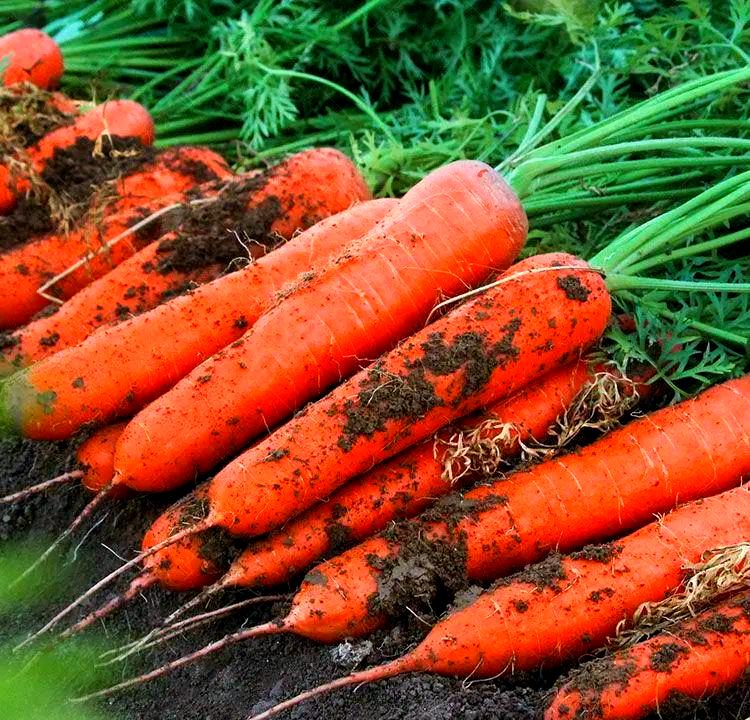
Carrot Nutrient Requirements
Carrots exhibit slow growth in the early stages, but rapid growth occurs in the mid-to-late stages when the root system begins to swell, and nutrient absorption increases accordingly. In the first two months after sowing, the absorption of various elements is relatively low. As the roots swell, absorption increases significantly, with potassium being the most abundant, followed by nitrogen, calcium, phosphorus, and magnesium, decreasing in that order. At harvest, the leaves contain the most potassium, followed by nitrogen, calcium, and magnesium, with very little phosphorus. The roots contain the most potassium and nitrogen, followed by phosphorus, calcium, and magnesium.
Carrots primarily require nitrogen in the early stages. Applying appropriate amounts of nitrogen fertilizer 30-50 days after sowing is essential. Nitrogen deficiency during this period leads to a significant reduction in root diameter and poor development of the fleshy roots. Different forms of nitrogen have a significant impact on carrot growth. Carrots absorb relatively little phosphorus, about one-third of their nitrogen uptake. When the available phosphorus content in the soil is low, applying phosphate fertilizer has a significant effect, and yield tends to increase with increasing fertilizer application. However, when the available phosphorus content exceeds 200 ppm, applying phosphate fertilizer has no yield-increasing effect and may even lead to yield reduction. For calcareous soils with a high phosphorus absorption coefficient, applying more phosphate fertilizer as base fertilizer is beneficial for early plant growth and later root enlargement. Potassium's main effect on carrots is root enlargement. When the soil's exchangeable potassium is below 150-200 ppm, potassium fertilizer application should be strengthened, especially during the root enlargement period, when topdressing with potassium fertilizer is necessary.
Carrot Fertilization Techniques: Carrots have deep roots and thrive in fertile, loose sandy loam. Deep plowing and sufficient base fertilizer should be applied before sowing. Fertilization significantly affects the shape of the root; a high amount of chemical fertilizer and low amount of organic fertilizer significantly increases the proportion of deformed roots. Applying well-rotted organic fertilizer as base fertilizer can reduce the formation of deformed rootlets. Applying unrotted organic fertilizer easily increases the likelihood of deformed roots.
In addition to base fertilizer, carrots require 2-3 topdressing applications. The first topdressing is applied 20-25 days after emergence, when the seedlings have developed 3-4 true leaves, using 5-6 kg of ammonium sulfate and 3-4 kg of potassium fertilizer per 667 square meters. The second topdressing is applied after the carrot seedlings have been thinned, using 7-8 kg of ammonium sulfate and 4-5 kg of potassium fertilizer per 667 square meters. The third topdressing is applied during the peak root expansion period, using the same amount as the second topdressing. Besides chemical fertilizers, well-rotted human manure can also be used, at 1000-2000 kg per 667 square meters. Topdressing can be applied by irrigation or by mixing human manure with water and sprinkling it on. Excessive fertilizer and water should be avoided in the later stages of growth, as this can easily cause root cracking and is not conducive to storage.